 Kecak (pronounced [ˈketʃaʔ], alternate spellings: Ketjak and Ketjack) is a form of Balinese music drama, originated in the 1930s and is performed primarily by men, although a few women's kecak groups exist as of 2006.[1]
Also known as the Ramayana Monkey Chant, the piece, performed by a circle of 150 or more performers wearing checked cloth around their waists, percussively chanting "cak" and throwing up their arms, depicts a battle from the Ramayana where the monkey-like Vanara helped Prince Rama fight the evil King Ravana. However, Kecak has roots in sanghyang, a trance-inducing exorcism dance.[2]
History
Kecak was originally a trance ritual accompanied by male chorus. German painter and musician Walter Spies became deeply interested in the ritual while living in Bali in the 1930s and worked to recreate it into a drama, based on the Hindu Ramayana and including dance, intended to be presented to Western tourist audiences. This transformation is an example of what James Clifford describes as part of the "modern art-culture system"[3] in which, "the West or the central power adopts, transforms, and consumes non-Western or peripheral cultural elements, while making 'art' which was once embedded in the culture as a whole, into a separate entity."[4] Spies worked with Wayan Limbak and Limbak popularized the dance by traveling throughout the world with Balinese performance groups. These travels have helped to make the Kecak famous throughout the world.
Performer, choreographer, and scholar I Wayan Dibia cites a contrasting theory that the Balinese were already developing the form when Spies arrived on the island.[5] For example, well-known dancer I Limbak had incorporated Baris movements into the cak leader role during the 1920s. "Spies liked this innovation," and it suggested that Limbak, "devise a spectacle based on the Ramayana," accompanied by cak chorus rather than gamelan, as would have been usual.[2]
 Gandrung is a traditional dance from Indonesia. Gandrung has many variations and is popular in Bali, Lombok and East Java,[1] among the Balinese, Sasak and Javanese (especially Osing Javanese). The most popular variation is Gandrung from Banyuwangi region[2] in the eastern peninsula of Java, so much that the city is often referred as Kota Gandrung or the City of Gandrung.[3]
Originally a ritual dance dedicated to the goddess of rice and fertility, Dewi Sri, it is currently performed as a social dance of courtship and love in communal and social events, or as tourist attraction.
Descriptions
Gandrung is named from Javanese word for love.[1] It is theorized that the dance originated in ritual dance to express love of the people to the rice goddess, Dewi Sri,[4] with trance and as a kind of fertility dance.[5] However, it is currently lost its ritual connotations, especially among Muslims Javanese and Sasak. The dance evolved into social dance describing a girl looking for love companions. The dance therefore has been de-ritualized, and mostly lost its connection with the rice divinity.
Gandrung usually performed in an all-night performance that begins sometime around 9 p.m. and ends just before dawn. [2] Gandrung is also commonly played as tourist attraction,[1] for example in Bali or in Grajagan Bay in Banyuwangi. It is also performed as social dance in communal and social events such as circumcision or wedding.
The "gandrung", or the main dancer, is usually an unmarried girl or a transvestite[6] (or simply boys playing the role of female dancers).[6][4] The dancer dressed in traditional costume, with fan, shawl and wearing ornamental headgear.[5] Often there are more than one gandrung dancer in the performance.
Gandrung usually started with the dancer(s) in side of stage surrounded by gamelan ensemble. When the music started, the dancer would start the dancing movement with hip thrusting and move to the center stage. When the gandrung spot an audience she wish to dance with she trow her shawl to the audience to bring him to the stage.[5] The dancer and the audience will then dance together as a dancing partner. If there are more than one gandrung dancer in the performance, each dancer will choose a partner and dance with their respective partners. The audience that had danced with the gandrung usually give small amount of money[1] as token of appreciations.
Gandrung is now also performed as dance of courtship and love, between girls and boys in central and eastern Lombok. It is usually performed outdoors by the young men and women of the village with everyone stands around in a circle.[7]
Similar dances are known throughout the Indonesian archipelago, such as ronggeng or tayuban in East and Central Java, jaipongan in West Java and Banten, and joged in Jakarta.
Music
The dance is performed to the tunes of a traditional ensemble similar with gamelan,[1][2] often composed of two violins, gendangs, bonang and gongs with gamelan xylophones (gambang). A singer is also present to sing the accompanying song for gandrung performance. [8] Villages in Banyuwangi, Bali and Lombok sometimes has their own gandrung music ensemble. Variance in ensemble composition existed between difference area where gandrung is performed [5] The music has been described as "vibrant and earthy" [2] and has been recorded by several anthropologists.
 Jaipongan, also known as Jaipong, is a popular traditional dance of Sundanese people, West Java, Indonesia. The dance was created by Gugum Gumbira, based on traditional Sundanese Ketuk Tilu music and Pencak Silat movements.
Background
In 1961, Indonesian President Sukarno prohibited rock and roll and other western genres of music, and challenged Indonesian musicians to revive the indigenous arts. The name jaipongan came from people mimicking of the sounds created by some of the drums in the ensemble. Audiences were often heard shouting jaipong after specific sections of rhythmic music were played. Jaipongan debuted in 1974 when Gugum Gumbira and his gamelan and dancers first performed in public.
The most widely available album of Jaipongan outside of Indonesia is Tonggeret by singer Idjah Hadidjah and Gugum Gumbira's Jugala orchestra, released in 1987, and re-released as West Java: Sundanese Jaipong and other Popular Music by Nonesuch/Elektra Records.
Gugum Gumbira
Gugum Gumbira is a Sundanese composer, orchestra leader, choreographer, and entrepreneur from Bandung, Indonesia. After 1961, when the Indonesian President Sukarno banned all forms of western music and challenged his people to revive their cultural music, Gugum Gumbira made this task his own. In order to do this he studied the rural, festival dance music for twelve years. His result was jaipongan. He created his own recording studio in Indonesia called Jugala.
Gugum Gumbira was born in 1945 in Bandung, Indonesia. He attended college in Bandung where he majored in social and political UNPAD. Once he left college, he took up a position at the Ministry of Finance and later moved to Government Vehicles. He also lectured at the Academy of Finance until 1988.
He currently owns a recording studio called Jugala where he conducts his orchestra also called Jugala and a dance troupe that shares the same name. They travel around the world to perform. As the choreographer for Jugala, he met his wife, Euis Komariah, who was the singer for the orchestra and a dancer in the troupe.
Musical origins
Jaipongan, also known as jaipong, is a musical performance genre of the Sundanese people in the Sundanese language of West Java, Indonesia. Jaipongan includes revived indigenous arts, like gamelan, but it also did not ignore Western music completely despite the ban on rock and roll. It used its sensuality and the sensuality found in a traditional village music and dance, ketuk tilu. However, many believe it is something purely Indonesian or Sundanese in origin and style. It is developed predominately from rural folk forms and traditions as a purely indigenous form. The rise of cassettes and films has led to the popularity of the musical form of jaipongan. It has spread from its home in West Java’s Sunda, to greater Java and Indonesia. It can be seen as many regional varieties of gong-chime performance found through much of Indonesia. As also an urban dance form, it is based primarily on the village forms of ketuk tilu and on the Indonesian martial arts, pencak silat. The musical genre is largely influenced from ketuk tilu with traces of the masked theater dance, topeng banjet and the wayang golek puppet theater. Ketuk tilu is its biggest influence, as a traditional Sudanese musical entertainment form.
Gong-chime performance is characterized by such features as: use of an ensemble dominated by idiophones, metallophones and knobbed gongs. It is a stratified polyphony, with lower-pitch instruments playing parts of lesser density and all parts are structured colotomically around time-cycles. This can be found in traditional Indonesian gamelan. There is improvisation on certain instruments. The modes used are grouped into two broad types: slendro and pelog.
Ketuk tilu was a musical genre based off ritual and celebration in the villages of the Sundanese people, meaning three kettle gongs. It was known for complex drumming coordinated with equally dynamic solo female dancers. The music was performed for planting and harvesting rituals and later celebrated village life, circumcision and marriage, expressed fertility, and displayed sensuality, eroticism and even sometimes “socially accepted prostitution.” Ketuk tilu was very popular in the Sundanese villages, but the urban Sundanese considered it unrefined and inappropriate because the music involved males and females dancing together suggestively, or mixed dancing between men and ronggeng, or prostitutes. Ronggeng probably has existed in Java since ancient time, the bas reliefs in Karmawibhanga section on Borobudur displays the scene of travelling entertainment troupe with musicians and female dancers.
Jaipong is less strictly associated with ceremonial functions, but performances are common in the Rayagung festival month, and with circumcisions and marriages. The performances now have the character of secular social functions, attended by young and old, primarily for entertainment and socializing. Public performance is now extremely frequent especially in clubs or street performances.
The cassette industry and its boom in Indonesia helped popularize jaipongan greatly and promoted regional styles rather than hurt them. Many learned the dance through cassette rather than the performance. The mass media have made jaipong ubiquitous. It has created competition in the styles of the drummers among ensembles. It has also helped to bring about many dance schools, altering dance and its label on females in West Java.
The song repertoire of jaipongan is varied, and that is why it is better understood as an intertwined performance style of music and dance. Many songs are associated with ketuk tilu or other wide reaching regional varieties, not traditional gamelan. It consists of songs of more recent origin often composed for jaipongan. Song topics vary, encompassing amatory, moralistic, bawdy, topical and spiritual subjects, often emphasizing grass roots culture.
Instrumentation & choreography
“A more slick and expanded version of ketuk tilu”
Jaipongan takes much of its instrumentation from ketuk tilu ensembles. The ketuk tilu group is composed of pot-gongs. Besides the core three main kettle gongs (ketuk, tilu meaning three), the instruments include a rebab, a small upright bowed instrument, also known as a spike fiddle, other small gongs — a hanging gong and two iron plates, and two or three barrel drums. The traditional singer is female or a sinden, but also dances and invites men to dance with her sensually, so it is assumed she is a prostitute or ronggeng. The ensemble is small enough to be carried from village to village to places where a saron or kempul may be added.
Ketuk tilu songs, following a free rhythmic introduction, are structured sectionally, juxtaposing segments of short gong cycles (about 10 seconds) with those of longer gong-cycles (about 30 seconds) each section having a characteristic sequence of dance steps associated with it.
Gumbira took and retrofitted the dynamic and intense ketuk-tilu music. The role of the singer was emphasized to concentrate just on the vocals. He added to it traditional gamelan by expanding the drum section of the ketuk tilu as more of an urban, unique gamelan orchestra from two drums to six. He also sped up the music significantly, increasing the dance role. He also modified the accompanying dance. The modifications retained some of the original sensual moves of ketuk tilu, joining to them a popular martial art called pencak silat. Gumbira called it jaipong. Jaipongan cassettes really feature the singer with their name and alluring cover photos. The singer is given greatest prominence, no longer seen as a prostitute but professional and respectful. This goes with the market demand for solo-superstars.
The idiophonic accompaniment of jaipongan may also include a few saron or a gegung (an L-shaped row of gong chimes), and often a gambang (xylophone). Otherwise instruments are the same as in ketuk tilu.
The large hanging gong and smaller gongs used in jaipong, like ketuk tilu and gong-chime performance, serve colotomic functions, punctuating the time-cycles at regular fixed intervals. The several ketuk play a standardized three-pitch figure, high, low, medium-low. The spike fiddle often imitates the singer and solos when the singer is silent. All the musicians, and especially the drummer, freely supplement the texture with rhythmic cries and yells called senggak. The most important roles become the singer and the drummer. The drummer is more aggressive and assertive than in other Sudanese/Javanese ensembles, commanding attention with a variable cadential figure before a large gong stroke. Jaipongan drumming is more virtuosic and flamboyant, the drummer performs lively improvisations throughout, building up tension that culminates and is released at the gong stroke. A distinctive Sundanese feature is the variation of the pitch of the main drum, whose head tension is governed by the foot of the drummer. The singer is the central figure carrying the melody and dancing at the same time. It is this lively interplay between the drummer and the singer that was carried from ketuk tilu, and is an identifying feature. The dance is centered around the gong cycles, in which the tension is built up before each large gong stroke where the dancers will gracefully jerk their heads toward each other.
The male jaipongan dance style is less acrobatic and martial than that found in ketuk tilu, simpler. Whereas the female dancer in jaipongan is very active, more than the ronggeng in ketuk tilu. It is very choreographed with a sophisticated polish different than the coyness role played by the ronggeg for the male advances in ketuk tilu.
The sectional formal structure of ketuk tilu is one feature that has not carried over to jaipongan. A jaipongan piece opens with a few gong cycles, often in a different tempo than the rest of the piece, during which the spike fiddle player improvises over the idiophone and drum accompaniment. The vocalist then enters, usually singing four gong cycles consecutively, then allowing the spike fiddler to improvise for two of theses gongan. The piece alternates in this way until it ends with a deceleration leading to the final gong.
The melodies are set to madenda, the Sundanese variant of the pelog mode, or slendro, or a free combination of the two, or an alternating combination. The melodies are usually in the pelog or madenda scales, while the fixed pitch idiophonic accompaniment is strictly in slendro. This combination contrasts with the gamelan tradition. The scales of these modes, intonation and tonic are difficult and not consistent, for more detail on this see: [1]. Intonation may be further obscured by the characteristic vibrato. These melodies in jaipongan can also be stereotypical; so much of the expressiveness and uniqueness comes in the introduction, improvised or pre-composed. It often establishes the modal pattern.
The verses are often organized into quatrains, each is one gong cycle, and in rhyme scheme aabbcc, each line having about eight syllables, as in most Sundanese folk and popular verse.
Social implications
In 1961, the president of Indonesia, President Sukarno created a ban on western music, mainly the genre of rock and roll, due to the fact that western ideas, themes, values and morals began to infiltrate the area. With the ban, Sukarno urged the public to “return to and revive the musical traditions of the past”. Gugum Gumbira heard this and deiced to create a genre of music that would revive the musical interests of the past and added sexual undertones and a sense of elegance in order to bring it into the future. In addition to being a musical reincarnation, jaipongan also reincarnated martial arts and traditional dance. It became so popular that the government decided that it needed to be taught to be people of all generations.
When jaipongan was first introduced in 1974, there was a lack of acceptable music in the area of West Java; Sunda more specifically. It gained popularity instantly because it was a completely non-western form of music that the government accepted and promoted. It had all of the values of traditional Sundanese music to entice the older generations, yet had enough energy, vibrancy, and sexuality to entice the younger generations. Jaipongan was also based on the life of the lower class and elevated their stories and struggles. It allowed the people to see themselves in the music and feel as if they were a part of their culture. Once it became popular, many other musicians began recreating it.
When situations in Sunda became more political, the music shifted and took on themes of moral, political, social, spiritual awareness. Once the shift occurred, the government tried its best to end jaipongan. Due to its popularity with the people, it was able to maintain its craze, and even out lasted the ban on Western Music.
The sexual nature of the songs was taken from the idea of prostitution, and was then elevated in order to make it a more elegant, civilized part of art. This broke gender barriers because it changed the way in which men and women interacted. Never before had men and women danced or interacted together in promiscuous or sexually explicit or suggestive ways in performance in Indonesia. Even though jaipongan was created to stay away from musical themes of sex, love, drugs, and rock and roll, it incorporated some of these themes in small increments. When the government discovered the sexual nature of the songs and dances, they looked to curb the popularity of jaipongan, but it had already become the music of the people and their efforts were thwarted.
Jaipongan was a way for the Sundanese people to take back their culture from the Western ideas and rid themselves of the colonial Dutch influences. Jaipongan elevated the idea of village music or music of the people. It focused on love, money, agriculture, and as the world became filled with more turmoil, it became a vehicle for moral, political spiritual, and social awareness.
Jaipongan became so popular that in 1976, two years after its creation, it was recorded on cassettes on Gumbira’s record label Jugala. With the cassette’s release international popularity rose and helped to create a larger musical industry in Sunda and Indonesia at large. All of which was and still is used to help preserve the culture and history of the West Java and the Sundanese people.
The rapid popularity of Jaipongan along with the boom in cassette tapes helped the genre to spread and become popular in Asia, Europe, and America during the 1980s. In addition it created a tourism industry in Sunda. People from all over the world came to learn about and experience Jaipongan first hand. Music and dance schools were created in order to preserve the art form and history of the Sundanese people. The government felt that Jaipongan was such a cultural staple that it needed to be taught to all citizens.
Jaipong today
In 2011, the international popularity of jaipongan has decreased, but in Asia, it’s still extremely popular. It’s most popular in the areas of Sunda, where it was created, as well as the surrounding villages and cities.
Although it’s most popular in Asia, there are jaipongan dance troupes and musical ensembles in Europe in addition to the United States (like Harsanari of San-Francisco) and throughout other parts of the world.
In 2011, jaipongan is noted as a modern classical concert genre of music, which is often sampled in other Asian music, and has multiple subgenres. There is still is a large market for jaipongan CDs and mp3s.
Film
The mass media has helped jaipongan become popular especially in the cinema but not as much as cassettes. There are many filmed performances online from students/audiences and dance documentaries from Java/Indonesia. Jaipongan songs have been taken and set to “Mr. Bean,” a character from western film, as well as other modern pop cultural references in youtube videos.
Music videos/performances of Tonggeret by Idijah Hadijah as well as other famous artists can be seen on youtube and also can be heard and referenced in use by Indian or Hindu film songs. There is a full-length film, called Mistri Ronggeng Jaipong, from Indonesia, made in 1982, by Mardali Syareif. A snippet can be seen here: Ronggeng Jaipong
There is also a Jean Hellwig film on popular dancing in West Java, 1989, with accompanying book and jaipongan chapter called Sundanese Pop Culture Alive.[2]A snippet can be seen in the reference section.
 Barong is a character in the mythology of Bali. He is the king of the spirits, leader of the hosts of good, and enemy of Rangda in the mythological traditions of Bali. Banas Pati Rajah is the fourth "brother" or spirit child that accompanies a child throughout life. Banas Pati Rajah is the spirit which animates Barong. A protector spirit, he is often represented by a lion, and traditional performances of his struggles against Rangda are popular parts of Balinese culture. The Barong is often portrayed with two monkeys.
The animal/ mythical creature would dance along the street to the calonarang dance. A priest would throw Holy Water at it.
It is known as the Demon Queen and Mother of All Spirit Guarders.
The lion barong is one of five traditional Barong. In Bali each region of the island has its own protective spirit for its forests and lands. Each Barong for each region is modeled after a different animal. There is a boar, a tiger, a dragon (or serpent) and the traditional lion. The lion is the popular one as it comes from the Gianyar region where Ubud (the home of tourist viewed ritual) is located. Within the calonarang, the dance drama in which the Barong appears, the barong responds to Rangda's use of magic to control and kill her to restore balance.

Reog Ponorogo
Reog is a traditional dance that become the main identity for Ponorogo Regency. Reog National Festival is held every years along the anniversary of Ponorogo regency and Grebeg Suro celebration. Reog dance is also staged full moon nightly in paseban, Ponorogo town square. Reog told about the struggle for a prince who will propose to a beautiful princess.[1] Reog Ponorogo tells the story of a mythical battle between the King of Ponorogo and the magical lion-like creature called Singa Barong. Singa Barong is a large mask usually made of tiger's or leopard's head skin, upon the mask attached a large fan adorned with peafowl feathers. The Singa Barong mask was notoriously heavy, the dancer of Singo Barong bear the mask about 30 – 40 kg weight and supported by the strength of their teeth.
Dance performance
The leading figures in Reog Ponorogo performance includes:
- Klono Sewandono, A men in regal attire wearing mask in proud and pompous dance, play the role as the King of Ponorogo
- Bujang Anom, rough youthful men wearing red mask, they performed acrobatic dances and sometimes also involved trance.
- Jatil, the youthful handsome horsemen riding horses made of weaved bamboo, similar to Kuda Lumping dance. Today Jatil usually performed by female dancers.
- Warok, played as Singa Barong, the mythical creature. The one that allowed to performed this mask dance is called warok. A warok is the hororary title of local hero or strongman of the village that possessed both exceptional spiritual and phyisical strength. The dance itself is demonstration of phyisical strength of the dancers.
Reog Ponorogo usually consists of three sets of dances; each dance is performed by several dancers:
- The first dance is the opening dance, performed by Bujang Anom, male dancers wearing black costumes. The costume describe rough men with intimidating moustache and other masculinity symbols.
- The second dance is the Jaran Kepang dance performed by Jatil; it is originally performed by a gemblak, a handsome and youthful teenage boy wearing colourful costumes. Today the female dancers were usually played this role.
- The third dance is the main attraction of the show; it is performed by all the Reog dancers. The warok as the main male dancer, wearing a large and heavy lion mask, dances in the centre of the stage while the other dancers dance around him. To demonstrate the warok's extraordinary strength Jatil or female dancers riding on top of lion mask and being carried around.
The dance describe Klono Sewandono the king of Ponorogo on his journey to Kediri to seek the hands of Princess Songgo Langit. On his journey he was attacked by a vicious monster called Singa Barong, a mythical lion with peacock on its head. Historians trace the origin of Reog Ponorogo as the satire on the incompetence of Majapahit rulers during the end of the empire. It describe the innate Ponorogo liberty and its opposition on centralist Majapahit rule. The lion represent the king of Majapahit while the peafowl represent the queen, it was suggested that the king was incompetent and always being controlled by his queen. The beautiful, youthful and almost effeminate horsemen describe the Majapahit cavalry that have lost their manliness.[2]
Reog Ponorogo dancers traditionally performed in a trance state. Reog Ponorogo displays the traditional Kejawen Javanese spiritual teaching. Next to physical requirement, the dancers—especially the Warok—required to follow strict rules, rituals and exercises, both physical and spiritual. One of the requirement is abstinence, warok is prohibited to indulged and involved in sexual relationship with women, yet having sex with boy age eight to fifteen is allowed. The boy lover is called Gemblak and usually kept by Warok in their household under the agreement and compensation to the boy's family. Warok can be married with a woman as their wive, but they may kept a gemblak too. This led to Warok-Gemblakan relationship that similar to pederastic tradition of ancient Greece. Anybody who is in touch with the traditional way of life in Ponorogo, knows that there are these older men called warok who, instead of having sex with their wives, have sex with younger boys.[3] What Warok and Gemblak did is homosexual act, yet they never identify themself as homosexuals.
Today this Warok-Gemblakan practice is discouraged by local religious authorities and being shunned through public moral opposition. As the result today Reog Ponorogo performance rarely features Gemblak boys to performed as Jatil horsemen, their position were replaced by girls. Although today this practice might probably still survived and done in discreet manner.
Controversy
The origins and cultural ownership of the Reog Ponorogo dance have been the subject of a dispute between the neighboring countries of Indonesia and Malaysia, whose ethnic, cultural and religious histories overlap and share many similarities. Mostly because there is numerous descendants of Javanese immigrants in Malaysia, especially in Johor state, and they brought many Javanese-origin artforms such as Wayang, Reog and Kuda Lumping.

e-wayang is a wayang which the whole process of its production use digital devices, facilities and tools to create tatah sungging e-wayang elements, including wayang shows that uses computerized media. The whole process went through electronic processing that wayang in digital format can be presented as digital shows with computerized program. Picture shown on the side of this article, is an example of the process in making an e-wayang.
E-wayang has two milestones, which are:
- based on Javanese year, Netra(2) Suci(4) Ambabah(9) Jagad Maya(1), shows year 1942 in Javanese Year
- based on Gregorian Year, Dewa(9) Ngulandara(0) ing Awang-awanging(0) Netra(2) shows year 2009
These milestones is the year of the making of the digital version of Ismaya, a god which travels on earth to tend the family member of Witaradya Clan.

Dialog/monolog dalam ludruk bersifat menghibur dan membuat penontonnya tertawa, menggunakan bahasa khas Surabaya, meski terkadang ada bintang tamu dari daerah lain seperti Jombang, Malang, Madura, Madiun dengan logat yang berbeda. Bahasa lugas yang digunakan pada ludruk, membuat dia mudah diserap oleh kalangan non intelek (tukang becak, peronda, sopir angkotan, etc).
Sebuah pementasan ludruk biasa dimulai dengan Tari Remo dan diselingi dengan pementasan seorang tokoh yang memerakan "Pak Sakera", seorang jagoan Madura.
Kartolo adalah seorang pelawak ludruk legendaris asal Surabaya, Jawa Timur. Beliau sudah lebih dari 40 tahun hidup dalam dunia seni ludruk. Nama Kartolo dan suaranya yang khas, dengan banyolan yang lugu dan cerdas, hampir pasti dikenal di seluruh Jawa Timur, bahkan hingga Jawa Tengah.
Ludruk berbeda dengan ketoprak dari Jawa Tengah. Cerita ketoprak sering diambil dari kisah zaman dulu (sejarah maupun dongeng), dan bersifat menyampaikan pesan tertentu. Sementara ludruk menceritakan cerita hidup sehari-hari (biasanya) kalangan wong cilik.

UNESCO designated Wayang Kulit, a shadow puppet theater and the best known of the Indonesian wayang, as a Masterpiece of Oral and Intangible Heritage of Humanity on 7 November 2003.
Wayang is a generic term denoting traditional theatre in Indonesia, Malaysia and Singapore. There is no evidence that wayang existed before Hinduism came to southeast Asia sometime in the first century CE. However, there very well may have been indigenous storytelling traditions that had a profound impact on the development of the traditional puppet theatre. The first record of a wayang performance is from an inscription dated 930 CE which says "si Galigi mawayang," or "Sir Galigi played wayang". From that time till today it seems certain features of traditional puppet theatre have remained. Galigi was an itinerant performer who was requested to perform for a special royal occasion. At that event we know he performed a story about the hero Bima from the Mahabharata.
Hinduism arrived in Indonesia from India even before the Christian era, and was slowly adopted as the local belief system. Sanskrit became the literary and court language of Java and later of Bali. The Hindus changed the Wayang (as did the Muslims, later) to spread their religion, mostly by stories from the Mahabharata or the Ramayana. Later this mixture of religion and wayang play was praised as harmony between Hinduism and traditional Indonesian culture. On Java, the western part of Sumatra and some smaller islands traditionalists continued to play the old stories for some time, but the influence of Hinduism prevailed and the traditional stories either fell into oblivion or were integrated into the Hinduistic plays.
The figures of the wayang are also present in the paintings of that time for example the roof murals of the courtroom in Klungkung, Bali. They are still present in traditional Balinese painting today.
When Islam began spreading in Indonesia, the display of God or gods in human form was prohibited, and thus this style of painting and shadow play was suppressed. King Raden Patah of Demak, Java wanted to see the wayang in its traditional form, but failed to obtain permission from the Muslim religious leaders. As an alternative, the religious leaders converted the wayang golek into wayang purwa made from leather, and displayed only the shadow instead of the figures itself. Instead of the forbidden figures only their shadow picture was displayed, the birth of the wayang kulit.
The wayang klitik figures are painted, flat woodcarvings (a maximum of 5 to 15 mm thick -- barely half an inch) with movable arms. The head is solidly attached to the body. With these, it is possible to do puppet plays either by day or by night. This type of wayang is relatively rare.
Wayang today is both the most ancient and most popular form of puppet theatre in the world. Hundreds of people will stay up all night long to watch the superstar performers, dalang, who command extravagant fees and are international celebrities. Some of the most famous dalang in recent history are Ki Nartosabdho, Ki Anom Suroto, Ki Asep Sunarya, Ki Sugino, and Ki Manteb Sudarsono.

Wayang kulit, shadow puppets are prevalent in Java and Bali, are without a doubt the best known of the Indonesian wayang. Kulit means skin and refers to the leather construction of the puppets that are carefully chiseled with very fine tools and supported with carefully shaped buffalo horn handles and control rods.
The stories are usually drawn from the Ramayana, the Mahabharata or the Serat Menak. The island of Lombok has developed its own style of Serat Menak called Wayang Sasak.
There is a family of characters in Javanese wayang called Punakawan; sometimes referred to as "clown-servants" because they usually are associated with the story's hero and also provide humorous and philosophical interludes. Semar is the father of Gareng (oldest son), Petruk, and Bagong (youngest son). These characters did not originate in the Hindu epics, but were added later, possibly to introduce mystical aspects of Islam into the Hindu-Javanese stories. They provide something akin to a political cabaret, dealing with gossip and contemporary affairs.
The puppets figures themselves vary from place to place. In Central Java the city of Surakarta (Solo) is most famous and is the most commonly imitated syle of puppets. Regional styles of shadow puppets can also be found in West Java, Banyumas, Cirebon, Semarang, and East Java. Bali produces more compact and naturalistic figures, and Lombok has figures representing real people. Often modern-world objects as bicycles, automobiles, airplanes and ships will be added for comic effect, but for the most part the traditional puppet designs have changed little in the last 300 years.
Historically, the performance consisted of shadows cast on a cotton screen cast an oil lamp. Today, the source of light in Java is most often a halogen electric light. Some modern forms of wayang such as Wayang Sandosa created in the Art Academy at Surakarta (STSI) has employed spotlights, colored lights and other innovations.
The handwork involved in making a wayang kulit figure that is suitable for a performance takes several weeks, with the artists working together in groups. They start from master models (typically on paper) which are traced out onto kulit (skin or parchment), providing the figures with an outline and with indications of any holes that will need to be cut (such as for the mouth or eyes). The figures are then smoothed, usually with a glass bottle, and primed. The structure is inspected and eventually the details are worked through. A further smoothing follows before individual painting, which is undertaken by yet another craftsman. Finally, the movable parts (upper arms, lower arms with hands and the associated sticks for manipulation) mounted on the body, which has a central staff by which it is held. A crew makes up to ten figures at a time, typically completing that number over the course of a week.
The painting of less expensive puppets is handled expediently with a spray technique, using templates, and with a different person handling each color. Less expensive puppets, often sold to children during performances, are sometimes made on cardboard instead of leather.

Wayang wong has fixed patterns of movement and costume:
For male performers:
- Alus: very slow, elegant and smooth movement. For example, the dance of Arjuna, Puntadewa and all other slimly built Kshatriyas. There are two types of movement, lanyap and luruh.
- Gagah:
- Gecul: ponokawan and cantrik
For female performers:
The movements know as nggruda or ngenceng encot in the classical, high style of dance consist of nine basic movements (joged pokok) and twelve other movements (joged gubahan and joged wirogo) and are used in portraying Bedoyo and Srimpi.
Today, the wayang wong, following the Gagrak style of Surakarta, is danced by women. They follow the alus movements associated with a Kshatriya, resembling Arjuna. Following the Gagkra style from Yogyakarta a male dancer uses these same Alus movements to depict Kshatriya noblemen. Costumes and props distinguish kings, Kshatriyas, monks, princesses, princes and generals. There are about 45 distinct character types
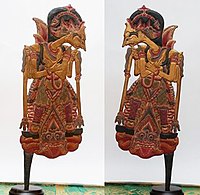
Wayang klitik figures come originally from eastern Java, where one still finds workshops turning them out. They are less costly to produce than wayang kulit figures.
The origin of the stories involved in these puppet plays comes from the kingdoms of eastern Java: Jenggala, Kediri and Majapahit. From Jenggala and Kediri come the stories of Raden Panji and Cindelaras, which tells of the adventures of a pair of village youngsters with their fighting cocks. The Damarwulan presents the stories of a hero (Damarwulan) from Majapahit. Damarwulan is a clever chap, who with courage, aptitude, intelligence and the assistance of his young lover Anjasmara, makes a surprise attack on the neighboring kingdom and brings down Minakjinggo, an Adipati (viceroy) of Blambangan and mighty enemy of Majapahit's beautiful queen Sri Ratu Kencanawungu. As a reward, Damarwulan is married to Kencanawungu and becomes king of Majapahit; he also takes Lady Anjasmara as a second wife. This story is full of love affairs and battles and is very popular with the public. The dalang is liable to incorporate the latest local gossip and quarrels and work them into the play as comedyThe wayang beber has strong similarities to narratives in the form of illustrated ballads that were common at annual fairs in medieval and early modern Europe. They have also been subject to the same fate – they have nearly vanished. A few scrolls of images remain from those times, found today in museums. Performances, mostly in small auditoriums, take place according to the following pattern:
The dalang gives a sign, the gamelan orchestra (or a musician with a violin-like instrument) begins to play and the Dalang unrolls a picture related to the story. Then, speaking and singing, he narrates the story in more detail. In this manner, in the course of the evening he unrolls several pictures. The pictures are shown one at a time and are successively unrolled. Each picture represents a story or part of a story. The content of the story typically stems from the Ramayana, the Mahabharata, the Jenggala stories or profane stories from other villages and kingdoms.